
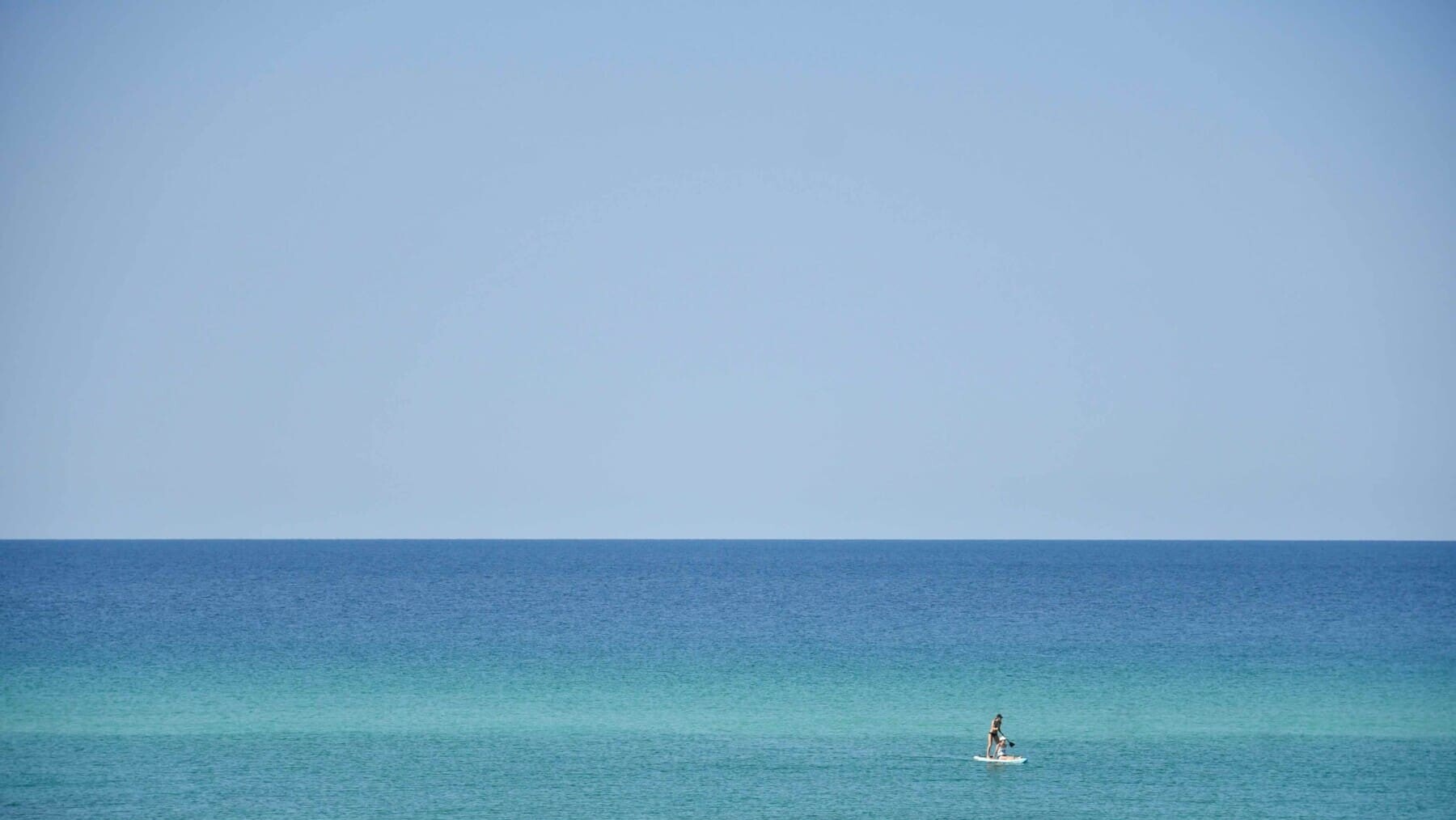
It’s one of the first questions people ask after they book: “Will the water be warm enough to actually get in?” On Siesta Key, the Gulf is almost never truly frigid—but it does shift from cool and crisp in winter to “stay in forever” warm in late summer.
This guide gives you a month-by-month look at typical water temperatures, plus what those numbers usually feel like once you’re standing at the shoreline with a towel in your hands. For the full month-by-month planning picture — crowds, weather feel, and seasonal rhythm — see our Best Time to Visit guide. Want to know which beach fits your group? Our Beach Guide covers access tips and the best match for every travel style.
How to use this guide: Start with the quick answers and the swim comfort planner, then jump to your travel month for the details. If you’re on the fence, check the live water temperature the day before your beach day.
Quick answers (the fast “should we swim?” version)
Warmest water
July–September
Comfortably warm (most swimmers)
May, June, October
Coolest water
January–February
Great middle-ground
April, November (refreshing, especially midday)
If you’re wondering “Is 72°F cold?” For many visitors, low 70s feels refreshing (best for shorter swims). Mid-70s is where a lot of people start calling it “comfortable.” Around 80°F+ is where most warm-water swimmers stop thinking about it.
Time your swim for comfort
If you’re visiting in winter or early spring, plan your swim for mid-to-late afternoon. The air warms up first, and the shallow water near shore often feels noticeably better than it did in the morning.
Swim comfort planner (pick your crew)
Plan fastWarm-water swimmers
- Best months: May–October (warmest: July–September)
- Best swim window: Any time; late afternoon still feels great
- Small tip: If the Gulf feels “oddly cool,” check a live reading before you commit to a long swim
Families with little kids
- Best months: April–June and September–October
- Best swim window: Early afternoon through late afternoon
- Small tip: Start in the shallows first—nearshore water can feel better than you expect
Cold-sensitive adults
- Best months: May–October (April/November are more “refreshing”)
- Best swim window: Mid-to-late afternoon
- Small tip: A lightweight rash guard makes a bigger difference than most people expect
“Quick dip” crew
- Best months: March, April, November
- Best swim window: Sunny afternoons
- Small tip: Plan a short dip, then a long shoreline walk—best of both worlds
Siesta Key water temperature by month (typical averages)
Important note (data source)
Siesta Key doesn’t have one official “beach thermometer.” For reliable month-by-month averages, NOAA provides coastal water temperature tables for nearby sites. The closest published location in that NOAA dataset on this stretch of the Gulf is Venice, Florida, which works well as a baseline for what most visitors can expect around Siesta Key. (Temperatures below are rounded to the nearest degree for readability.)
NOAA retired the Coastal Water Temperature Guide site in 2025, but the monthly temperature tables remain available and are still a reliable baseline for planning.
| Month | Typical water temp (°F) | How it usually feels |
|---|---|---|
| January | 64°F | Brisk (quick dips, not long floats) |
| February | 66°F | Brisk (cold-front weeks feel extra chilly) |
| March | 70°F | Cool but doable (sunny afternoons help) |
| April | 75°F | Comfortable for most swimmers |
| May | 81°F | Warm (easy swimming) |
| June | 85°F | Very warm (long swims feel great) |
| July | 87°F | Bath-like warm |
| August | 87°F | Bath-like warm |
| September | 86°F | Very warm |
| October | 80°F | Warm (one of the best-feeling months) |
| November | 73°F | Refreshing (quick swims feel great) |
| December | 67°F | Cool-to-brisk (depends heavily on weather) |
Best months for swimming (by comfort level)
Pick the comfort style that matches your crew, then scroll to your travel month for the details.
Warm, easy swimming
May, June, October tend to feel warm without always having the “peak summer” heat factor.
Warmest possible Gulf water
July, August, September are typically the warmest—best for long swims and daily water time.
Refreshing, still swim-friendly
April and November often feel crisp in a good way, especially on sunny afternoons.
If cold water is a dealbreaker
January and February are usually the toughest for warm-water swimmers. Plan beach time first, swimming second.
Why the water can feel colder (or warmer) than you expected
These are the most common reasons a day can feel “different” than the monthly average—plus what to do about it.
Why it changes
- Cold fronts: A cool, breezy stretch can drop “comfort” fast in winter and early spring.
- Nearshore vs offshore: Shallow water warms/cools quicker than deeper water.
- Upwelling: Wind can shift surface water so cooler water rises closer to shore for a day or two.
What to do
- Check a live reading the day before (and morning of) your beach day.
- Aim for afternoon swims in cooler months—comfort is usually best then.
- Start in the shallows before you commit to a long float.
- Bring a rash guard if you’re on the edge—wind is often the real culprit.
Best last-minute move: For a close-to-Siesta reading, check NOAA’s Siesta Key, Big Sarasota Pass station page (Water Temp/Conductivity is listed as an available product).
Optional backup: NOAA’s offshore WFS Central Buoy (42013) reports sea surface temperature if you want a second reference point.
Two small things that make cool-water months more fun
A lightweight rash guard (helps with wind + sun and keeps you comfortable longer).
A quick-dry towel and a warm top for after swimming (the breeze is what gets most people).
Siesta Key water temperature: month-by-month details
January (64°F): brisk, best for quick dips
January is usually the coldest-feeling swim month. You’ll still see people get in—especially kids—but most adults treat it as a quick-dip month. Plan beach walks, sand time, and sunsets, with swimming as a bonus.
Best swim window: Early afternoon through late afternoon is usually the most comfortable.
February (66°F): similar to January, with big week-to-week swings
February often feels like January’s twin. On warm, sunny afternoons it can be doable. After a cool-weather stretch, it can feel sharply cold. Great month for shell hunting and long shoreline walks.
Best swim window: Early afternoon through late afternoon is usually the most comfortable.
March (70°F): cool, but many visitors start swimming again
March is a turning point. A lot of visitors consider ~70°F manageable, especially when the sun is strong. If you tend to run cold, plan shorter swims and aim for later in the day.
Best swim window: Early afternoon through late afternoon is usually the most comfortable.
April (75°F): comfortably swimmable for most people
April is when the Gulf starts feeling truly inviting again. It’s a strong month for beach days that include real swimming—not just wading. Many families find April hits that “everyone’s happy” range.
Best swim window: Early afternoon through late afternoon is usually the most comfortable.
May (81°F): warm, easy swimming
May is a favorite for warm-water swimmers who don’t want the hottest months of the year. The Gulf usually feels warm enough for long swims, float time, and hanging in the shallows without thinking about it.
Best swim window: Any time of day usually feels good, with late afternoon still a favorite.
June (85°F): very warm, long-swim friendly
June is reliably warm in the water. This is when the Gulf starts feeling like you can stay in forever—especially on calm days.
Best swim window: Any time of day usually feels good.
July (87°F): peak warmth (bath-like)
July is about maximum warmth. The Gulf can feel like a giant warm pool—amazing for floating and long swims.
Best swim window: Any time of day.
August (87°F): still peak warmth
August stays in that top-warm range. If your crew wants near-guaranteed warm water, this is one of the strongest bets.
Best swim window: Any time of day.
September (86°F): very warm, often one of the best swim months
September keeps late-summer warmth and can be an incredible month for water lovers. If warm Gulf water is your #1 priority, September delivers.
Best swim window: Any time of day, with late afternoon still feeling great.
October (80°F): warm, comfortable, “best of both worlds”
October is a classic for many visitors: the Gulf is still warm, and the water often feels perfect—warm enough for long swims without always feeling like the peak of summer.
Best swim window: Early afternoon through late afternoon is usually the most comfortable.
November (73°F): refreshing, still swim-friendly for many
November is where preferences split. Plenty of visitors still swim comfortably—especially midday. If you prefer a crisp, refreshing dip, you’ll love it.
Best swim window: Early afternoon through late afternoon is usually the most comfortable.
December (67°F): cool-to-brisk, depends heavily on the weather
December can be surprisingly pleasant on warm, sunny days, but the Gulf is usually cool. Think wading, splashing, and shorter swims depending on the week’s weather.
Best swim window: Early afternoon through late afternoon is usually the most comfortable.
FAQs
What is the coldest month for Siesta Key water temperature?
Typically January is the coldest-feeling month, with February close behind. Many visitors still wade or do quick dips, but long swims are less common.
What is the warmest month for Gulf water on Siesta Key?
Usually July and August are the warmest, with September close behind. This is when the Gulf often feels “bath-like.”
Is April warm enough to swim at Siesta Key?
For many people, yes—especially on sunny afternoons. It often feels comfortably swimmable, though still refreshing if you’re used to very warm water.
Is the water warm enough in November?
Often yes for a refreshing swim, especially midday. If you’re sensitive to cold, October is usually a safer pick.
Why is the water sometimes cold even when the weather is hot?
Wind and currents can shift surface water, and sometimes cooler water rises closer to the surface near shore for a day or two (often called upwelling).
How can I check the water temperature right before our trip?
Check a live NOAA station reading the day before and the morning of your beach day. NOAA’s Siesta Key, Big Sarasota Pass station lists Water Temp/Conductivity as an available product.
When is the water warm enough for kids to swim comfortably?
Many families find late spring through early fall easiest for daily swimming, with April and November feeling more refreshing than warm depending on the week.
Does the water temperature change a lot from day to day?
It can—especially in winter and spring. Weather patterns and wind can shift what you feel near shore, which is why checking a live reading right before your beach day is so helpful.
Related Guides
If water time is a big part of your trip, these guides help you plan the rest of the details.
Weather + crowd feel by month to help you choose the right travel window.
Which beach fits your vibe, with access tips and what to expect.
When the Gulf tends to look its clearest — and what can change it.
Water adventures, Village nights, day trips, and 1/3/7-day plans.
Best times, best beaches, and how water conditions affect your finds.
What to know if you’re visiting during nesting season (May–October).
What to Pack for Siesta Key (By Season)
Simple packing choices that make beach days easier in every season.
Siesta Key Beach Parking Guide
Best arrival windows by season — so your beach day starts smooth.
Walkability, trolleys, bikes, and the easiest ways to move around.
First-Timer’s Guide to Siesta Key
The complete planning framework for first visits.
Find your Siesta Key vacation rental
Browse our handpicked homes and condos — walkable locations, 5-star stays, and local support that makes your trip feel effortless.
-
✓
Best trips start with the right location — filter by beach access, Village proximity, and more.
-
✓
Comfort-forward amenities — pools, kitchens, parking, and the “little things” families love.
-
✓
Local team — real people, real help, and insider tips once you arrive.